
If you’ve been researching brain stimulation therapies, you’ve probably come across both deep TMS and traditional TMS. They’re related, but not the same. The differences matter when you’re weighing which approach might fit your situation. Both are non-invasive, FDA-cleared options for certain mental health conditions. They diverge in coil technology, penetration depth, and which conditions each is approved to treat. For anyone exploring deep TMS treatment for the first time, understanding those distinctions is a reasonable starting point.
What Is Deep TMS?
Deep TMS, sometimes written as dTMS, is an advanced form of transcranial magnetic stimulation. Like traditional TMS, it uses magnetic pulses to stimulate specific brain areas involved in mood regulation and behavior. The key distinction is the technology. dTMS uses a specialized helmet containing an H-coil that can reach brain structures 3 to 4 centimeters beneath the scalp. Traditional coils, by comparison, typically reach about 1 centimeter. Differences in depth affect which neural networks are targeted and may influence how well the treatment works.
The H-coil also produces a broader magnetic field, covering more neural pathways at once. Standard coils focus on a narrower area, which is an advantage for some conditions and a limitation for others. dTMS was developed specifically to address conditions in which the relevant brain circuits lie deeper than surface-level stimulation can reach. Understanding how TMS therapy works at the neurological level helps clarify why penetration depth matters as much as it does.
How Deep TMS Differs from Traditional TMS
The clearest way to understand the difference is to look at what each treatment does in the brain. Traditional TMS uses a figure-8 coil positioned against the scalp. It delivers a focused, concentrated field to cortical areas, primarily the brain’s surface. The left dorsolateral prefrontal cortex is the most common target for depression. The precision of this approach is one of its strengths. It allows clinicians to stimulate a specific region with high accuracy.
dTMS is a little different. The H-coil is built into the helmet-shaped device. It allows for a wider field of view that extends deeper into the brain. A wider field means it can affect subcortical structures, deeper networks that help manage emotions and reward. If those circuits are more involved in the disorder, then perhaps a wider stimulation field will have a greater impact. The downside is reduced precision, as it affects more brain tissue than a tightly focused target.
The treatment course is similar for both treatments. Typically 4-6 weeks of daily treatments, Monday through Friday. Each session lasts between 20 and 40 minutes. Neither requires sedation, and most people can resume normal activities right afterward.
Standard vs. Deep TMS: A Feature Comparison
A 2025 clinical review from the National Library of Medicine compared the two technologies. It reviewed major device and clinical specifications. It covered helpful information to consider when looking at deep TMS vs. TMS for a particular condition. The table below highlights the research study. Note the row about contraindications if you have cochlear implants or other metal electrical devices near your head. Both technologies have the same restriction.
| Device Feature | Standard TMS (rTMS) | Deep TMS (dTMS) |
| Primary Coil Architecture | Figure-8 coil design | H-coil housed within a custom helmet |
| Target Penetration Depth | Focal; up to 1 cm beneath the scalp | Broad; 3 to 4 cm into subcortical networks |
| Electric Field Geometry | Highly concentrated, focal target area | Wider, deeper volume of neural pathways |
| Addressing Placement Error | Sensitive to minute shifts; requires precise spatial tracking | Mitigated by structural width; covers larger target networks |
| Core FDA Clearances | Major Depressive Disorder (MDD) | MDD, OCD, Smoking Cessation |
| Absolute Contraindications | Metal implants within 30 cm of coil | Metal implants within 30 cm of coil |
Conditions Treated with Deep TMS
FDA clearance for dTMS covers several specific conditions, and research continues to expand its potential applications. The conditions with the strongest clinical backing are those where deeper brain circuit involvement is well established. Below are the three most commonly treated conditions. Each has its own dedicated page with more detail on how protocols are applied and what the research shows.
Deep TMS Therapy for MDD
Deep TMS therapy for MDD is one of the most well-studied uses of the treatment. In fact, treatment-resistant depression was the original indication for TMS therapy as a whole. dTMS has shown equivalent or slightly better response rates for some subgroups, such as older adults. Response rates are typically in the same ballpark as traditional TMS, around 50 to 60 percent. Patient populations make it difficult to draw direct comparisons between the two. If you haven’t responded adequately to medication or talk therapy, both options should be considered in conversation with your doctor.
Deep TMS for OCD
Deep TMS for OCD was granted its own standalone indication from the FDA. Clinical trials found significant decreases in OCD symptom severity. The H-coil allows us to target the circuitry connecting the prefrontal cortex and deeper limbic regions, which can become hyperactive in OCD. If SSRIs and talk therapy haven’t given you the relief you need, dTMS could represent a significant advancement in your treatment. It has a lot to do with dTMS’s wider stimulation field. OCD is a disorder of deeper, more distributed networks than standard TMS can reach.
Deep TMS for Anxiety
Deep TMS for anxiety is a relatively new application of the treatment. Like depression, anxiety disorders commonly overlap. Many patients who seek out dTMS are treating both conditions at once. By reaching deeper into the brain, we’re able to target circuits between the prefrontal cortex and limbic regions. These are closely tied to our fear responses and emotional reactivity. Deep TMS was granted FDA clearance for anxious depression, which has allowed many patients with generalized anxiety symptoms to receive the treatment.
Is Deep TMS More Effective Than Traditional TMS?
This is the question most people want answered directly. The honest answer is that it depends on the condition and the individual. For depression broadly, both technologies show comparable results. Response rates fall in the 50-60 percent range for both. Remission is achieved in roughly 30 to 40 percent of patients. Some studies suggest dTMS produces modestly higher response rates in specific subgroups. The evidence doesn’t support a clear overall advantage for either approach.
Where dTMS shows a more distinct advantage is in conditions involving deeper brain circuits. OCD is the clearest example, given its dedicated FDA clearance based on trial evidence showing meaningful symptom reduction. For smoking cessation, both have FDA approval, and the choice often comes down to provider availability and clinical preference. The evidence base for dTMS continues to grow across additional conditions as well.
The more useful frame isn’t which technology is better overall. It’s which one suits a specific diagnosis, treatment history, and brain target. Someone who hasn’t responded to traditional TMS may respond to dTMS. A person with a focal cortical target may do just as well with standard TMS. Understanding how long results last is also part of the conversation, since durability varies by condition and protocol.
What to Expect During Deep TMS Treatment
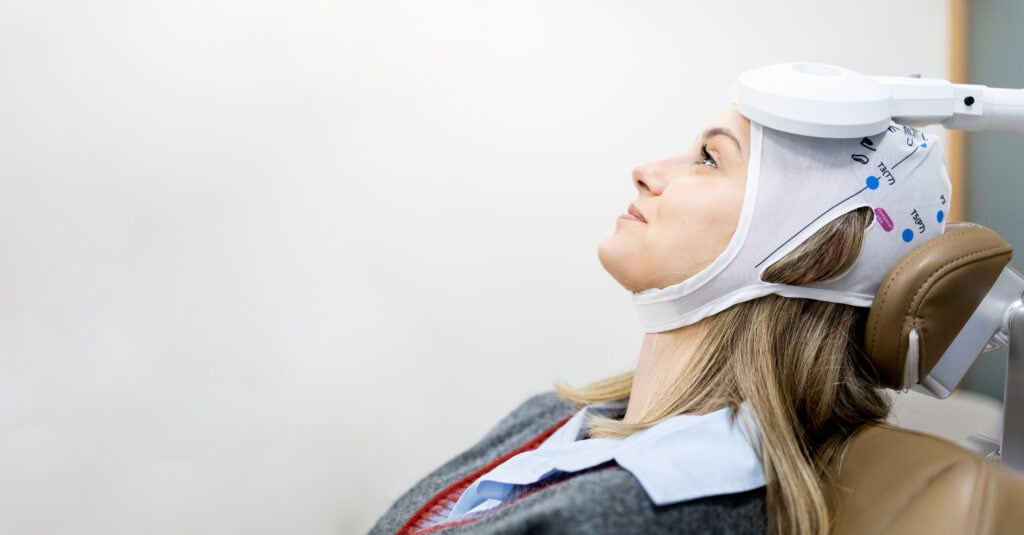
The experience of a deep TMS therapy session is similar to traditional TMS in most practical respects. You’ll sit in a chair while a technician positions the helmet device over your head. The H-coil delivers magnetic pulses during the session, producing a tapping or mild pressure sensation on the scalp. Most people find this tolerable, and any discomfort tends to ease within the first few sessions as settings are adjusted.
Sessions last approximately 20 minutes for many dTMS protocols, which is somewhat shorter than those of some traditional TMS protocols. No sedation is involved. You remain awake and alert throughout. Afterward, there’s no recovery time required, and most people drive themselves to appointments and continue their normal day. A physician monitors progress throughout the course and adjusts protocol parameters when needed.
The most common side effects reported with deep TMS treatment include mild scalp discomfort, temporary headache, and occasional lightheadedness. These are generally short-lived and resolve shortly after the session ends. Neither traditional nor dTMS is associated with cognitive impairment, which distinguishes both from older neuromodulation approaches. Serious adverse events are uncommon when treatment is delivered by trained clinicians following FDA-cleared protocols.
Which Option Is Right for You?
Several factors shape which approach makes more sense for a given person. Diagnosis is the most important starting point. For MDD without prior TMS experience, traditional TMS is often the first step given its wider availability. If OCD is part of the picture, dTMS has a clearer evidence base and specific FDA clearance. If anxiety is the primary concern or co-occurring with depression, dTMS offers broader circuit coverage relevant to that presentation.
Treatment history also matters. If traditional TMS hasn’t produced adequate results, dTMS is a reasonable next step. Its deeper reach and different stimulation profile may achieve what standard protocols couldn’t. Provider availability is a practical consideration as well, since dTMS requires specialized equipment and trained staff. Not every clinic offers it, and knowing that upfront helps with planning.
The following factors are worth discussing with your physician when weighing the options:
- Whether your diagnosis falls under an FDA-cleared indication for dTMS specifically
- Whether you’ve had a prior course of traditional TMS and what the outcome was
- Whether your symptoms suggest deeper brain circuit involvement
- Whether metal implants near the head or other contraindications apply
- Whether your insurance covers dTMS for your specific diagnosis
No article can substitute for a physician evaluation. What it can do is help you arrive at an appointment with better questions. At Shanti TMS, the evaluation process involves assessing your specific situation against the available evidence. Whether comparing deep TMS vs TMS or deciding between the two, it starts with that conversation.

FAQs About Deep TMS Treatment
These are questions we hear from people who want more than a surface-level answer before committing to a consultation.
Does dTMS hurt more than traditional TMS?
Most people find it tolerable, with a tapping or mild pressure sensation similar to traditional TMS. Settings are adjusted throughout the course to manage comfort, and any discomfort typically fades within the first few sessions.
Can dTMS be combined with medication or psychotherapy?
Yes, and it often is. dTMS is frequently used alongside ongoing medication or behavioral therapy. For conditions like OCD, combined approaches tend to produce stronger outcomes. Your physician factors your current treatment plan into the protocol design.
Does insurance cover deep TMS?
Coverage depends on your specific plan and diagnosis. Many insurers cover it for FDA-cleared indications such as MDD and OCD when medical-necessity criteria are met. The team at Shanti TMS handles benefits verification and prior authorization before treatment begins.
How is the H-coil positioned compared to a standard coil?
The H-coil sits inside a helmet that fits over the head, rather than a handheld device placed against the scalp. Some people find the helmet more comfortable since it doesn’t require manual repositioning mid-session. The sensation during stimulation is broadly similar to standard TMS.
What happens if dTMS doesn’t produce enough improvement?
A physician monitors response throughout the course and can adjust stimulation parameters or session frequency. If the full course doesn’t achieve the desired outcome, next steps may include a modified protocol or maintenance sessions.