
When medications stop working and therapy starts feeling like going in circles, it is easy to wonder if anything will ever help. We hear that kind of exhaustion often, and it is exactly the situation Transcranial Magnetic Stimulation (TMS) was developed for. Understanding how TMS therapy works starts with one key difference: rather than adding another drug to your system, this approach works directly with your brain using gentle magnetic pulses. At Shanti TMS in Portland, your entire plan is built around what your brain actually needs.
The Neuroscience Foundation: How Does TMS Work
Depression is often described as a chemical imbalance, but that explanation only tells part of the story. The brain operates as a network of circuits, and in people living with depression, one pathway tends to go quiet. The left dorsolateral prefrontal cortex governs mood, motivation, and clear thinking. It shows reduced activity in those who have not responded to antidepressants. TMS wakes that region back up through targeted magnetic stimulation rather than introducing another pharmaceutical into the body.
During a session, a small coil rests against the scalp and sends brief magnetic pulses to the specified area. Those pulses travel through the skull and encourage the neurons in that region to fire more consistently. The physics involved mirror those used in MRI technology, though applied here with far greater precision. Antidepressants alter neurotransmitter levels across the entire central nervous system, reaching organs well beyond the brain. TMS acts only on the targeted circuit, which is a significant reason why most patients tolerate it so well.
What Happens at the Neural Level During rTMS
When someone has tried medication after medication without feeling better, there is often a real neurological reason behind it. A region in the front of the brain called the left prefrontal cortex plays a central role in mood and motivation, and in people with treatment-resistant depression, it tends to go quiet. Medications work by adjusting chemical levels throughout the nervous system, but that broader approach does not always reach that one specific area the way it needs to. TMS goes directly there, delivering focused magnetic pulses to wake that region back up and encourage those neurons to fire again in ways medication alone often cannot.
Lasting neurological change takes more than one session, and the protocol is built to reflect that. Visiting 5 days a week over several weeks allows each appointment to build on the previous one. Over time, those visits strengthen the connection between the prefrontal cortex and the emotional centers deeper in the brain. When that communication pathway weakens, regulating mood becomes genuinely difficult regardless of how much effort a person puts in. rTMS works to restore those connections through targeted, repeated activation rather than circulating a compound throughout the whole body.
Protocol selection depends on each patient’s diagnosis and symptom history. For depression, a higher-frequency approach increases activity in the underperforming prefrontal region. For OCD, where certain circuits are overactive, a lower-frequency protocol quiets that pattern instead. Theta burst stimulation delivers comparable neurological benefit in a shorter window, making it a practical option for those with demanding schedules.
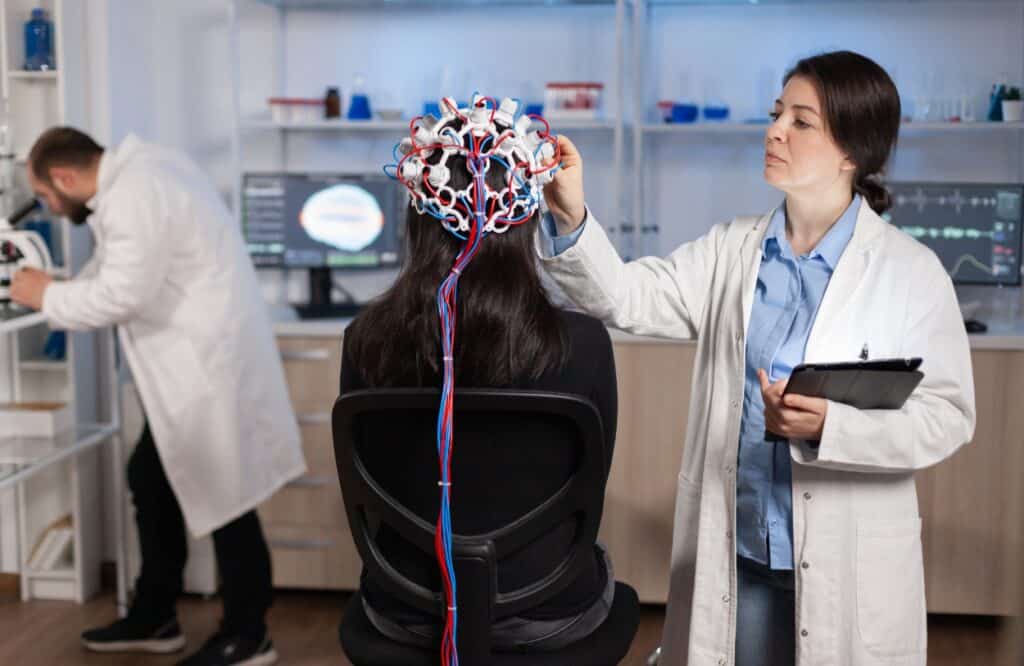
How TMS Therapy Works on the Brain Across Different Conditions
Depression, OCD, and anxiety each involve distinct brain circuits misfiring in their own ways, and TMS accounts for that specificity. In depression, the prefrontal cortex tends to go quiet in ways that make motivation and mood regulation difficult to sustain. OCD involves a separate loop connecting the prefrontal cortex, the striatum, and the thalamus. Unlike depression, this loop fires too much. Anxiety follows a similar pattern of overactivation, where particular networks keep signaling an alarm that the situation does not warrant. TMS can be directed at each pathway precisely, which is why its clinical applications have grown steadily over the years.
The research behind TMS is one of the things patients find most encouraging when they first learn about it. Studies show that 50% to 60% of patients who did not respond to antidepressants saw significant improvement with TMS. Around 1 in 3 of those patients reached full remission, meaning symptoms resolved entirely rather than just becoming more manageable. For someone who has tried option after option, those numbers represent something real and worth knowing.
At Shanti TMS, a physician reviews each person’s complete history before selecting any protocol. Prior approaches, how each was tolerated, and the current symptom picture all shape the decision about where to direct stimulation. Intensity is calibrated based on that full picture as well. As visits progress, the physician continues adjusting based on how each person responds. No fixed schedule set at the outset governs the entire course. No two courses look exactly alike here, because no two histories or needs are identical.
Neuroplasticity: Why the Effects of TMS Last
One of the most common questions we hear is whether the progress actually holds once the sessions are done. With most medications, relief depends on the drug staying in your system, and when a prescription ends or a dose shifts, symptoms often return. TMS works differently. Rather than asking your brain to respond to a chemical, it gives your brain a repeated signal to strengthen the circuits involved in mood regulation. Those changes stay with you because they belong to your brain, not to something it is relying on.
Neuroplasticity simply means the brain can reorganize itself when it receives the right kind of repeated input. Think of it like recovering function after an injury or building a skill through consistent practice. rTMS uses that same mechanism in a focused, deliberate way, and each visit builds on the one before it. By the end of a full course, those neural pathways have genuinely shifted. Many patients describe it as the difference between managing something day to day and actually moving through it, and that shift tends to hold well beyond the final session.
How Long Does TMS Take to Work
Most patients come in 5 days a week for 4 to 6 weeks, and each visit is shorter than most expect. Depending on the protocol a physician recommends, appointments typically run between 20 and 40 minutes. Some options, like theta burst stimulation, wrap up in just a few minutes once a session is underway. No anesthesia, sedation, or recovery time is required, and most people head straight back to work when the visit ends.
The timeline looks different for everyone, and we are upfront about that from the start. Some patients notice a shift in early weeks, often something quiet, like waking up without feeling as heavy as before. For others, changes arrive a little later, around week 3 or 4, and progress often continues even after the final session. Our physicians check in at every visit, and if an adjustment is needed, we address it while the course is still active.

Safety, Tolerability, and What to Expect
Safety is usually the first thing people ask us about, and it is one of our favorite questions to answer. TMS has a strong safety record built over decades of clinical use and research across thousands of patients. Your body is not involved in the way it is with medication. Nothing is injected, nothing is swallowed, and no sedation is needed at any point. You stay completely awake throughout each session, and most people head right back to their day feeling no different than when they walked in.
The most common thing people notice in the first few sessions is a light tapping sensation on the scalp, right where the coil sits. For most patients, that feeling fades considerably within the first week as the body gets used to the stimulation. Occasionally, someone will mention a mild headache after an early visit, but it tends to resolve on its own within an hour or so. Serious side effects are genuinely rare. At Shanti TMS, a physician is on-site for every single session, so if anything comes up, there is always someone with real medical authority right there with you.
Why Shanti TMS in Portland
When someone calls our facility for the first time, they often arrive at that conversation having already tried a great deal. Medications that did not work, therapy that helped only so much, and a growing sense that available options were narrowing. The difference at our center starts with focus, as TMS is not one service among several here. The entire practice is built around this single specialty. Every physician and staff member works with it as their full clinical focus each day. The depth of experience that comes from that concentration shapes the quality of care from the very first appointment forward.
Shanti TMS runs one Portland location, so every patient sees the same familiar faces throughout the entire course. There are no transfers to an unfamiliar provider and no need to repeat a personal history to someone new. No gaps exist in who holds the full picture of each person’s progress. A licensed physician is on-site at every appointment, monitoring how things are going and refining the protocol as the course develops. For anyone who has felt like a file number in a large healthcare system, that kind of consistent presence feels different.
Insurance and Access
Worrying about cost is usually the first thing patients mention when they call us, and we expect it. TMS is a meaningful commitment, and navigating insurance paperwork on top of everything else can feel like too much. Our team contacts your insurance provider directly, verifies your benefits, and handles prior authorizations. We want you to have a clear picture of your coverage before your first visit begins. We want the financial side resolved before you ever walk through the door.
If a claim gets denied, we do not stop there. Our staff files appeals on your behalf and walks you through every step with honest, straightforward information about what to expect. Many major insurance plans now cover TMS for treatment-resistant depression. We work to make sure you receive every benefit your plan allows. A free consultation is the right starting point to understand whether TMS fits your situation and what your coverage may include.